


Modern businesses operate in a world of connectivity and collaboration. Every enterprise, regardless of its size must interact with a lot of business contacts. Be it, customers, business partners, suppliers, and service vendors.
When supply chain and product/service quality is at stake, removing communication gaps is non-negotiable. B2B integration streamlines this process by automating communication and collaboration, ensuring smooth interactions across the supply chain.
Over the years, customers data and system integration needs have evolved. Traditional integration methods are no longer enough for seamless communication between businesses.
Challenges and Complexities in B2B Integration
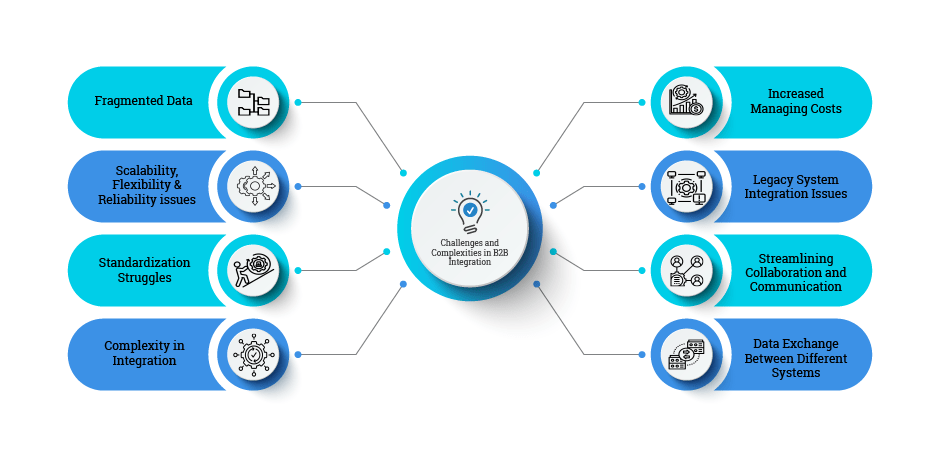
Enterprises often deal with an array of challenges that hinder the smooth flow of data and processes across their ecosystems. Being aware of these challenges can help enterprises understand their business landscape. Let’s look at these challenges below:
- Fragmented Data/Data Silos: Enterprises often struggle with data scattered across disparate systems, resulting in blind spots and inefficiencies.
For instance, a manufacturing company might have three systems for order information, inventory data and shipping details. This makes it challenging to get a comprehensive view of operations. This lack of visibility can result in missed opportunities, delayed responses to market trends, and loss of competitive advantage.
- Scalability, Flexibility & Reliability Issues: Traditional integration approaches may struggle to keep pace, leading to scalability and flexibility issues.
Imagine an e-commerce platform experiencing a sudden surge in orders during a holiday season. Traditional integration methods will lead to system downtime, poor customer experiences, and missed revenue opportunities.
The need scalability, flexibility, and reliability that can accommodate their ever-evolving businesses.
- Standardization Struggles: Diverse systems, data formats and standardization can complicate communication and integration efforts. Disparate systems and data hinder effective communication and collaboration. Without a unified framework, face data errors, compliance issues, and increased operational costs.
- Complexity in Integration: Integrating various systems, applications, and protocols can be complex and time-consuming.
For instance, a financial services firm might be looking to integrate its CRM with its accounting software and third-party payment gateways. They might face the challenge of ensuring compatibility and data consistency. This complexity can lead to longer project timelines, higher integration costs, and missed business opportunities.
- Increased Managing Costs: Traditional integration methods involve significant upfront costs in infrastructure and maintenance. This also diverts resources away from core business activities and innovation initiatives.
- Legacy System Integration Issues: Enterprise often rely on legacy systems that are unable to handle modern cloud-based applications. This leads to interruption in seamless data exchange and interoperability across the enterprise ecosystem.
- Difficulty in Streamlining Collaboration and Communication: Lack of efficient communication channels can disrupt collaboration between internal teams and external partners. This leads to errors, rework, and missed deadlines, eroding operational efficiency and customer satisfaction.
- Difficulty in Data Exchange Between Different Systems: Different data formats and systems can pose as a challenge to smooth data transfer. This leads to data errors and processing delays. For instance, a logistics company receiving shipment information from various carriers in different formats (XML, JSON, CSV) faces the challenge of standardizing and processing this data efficiently.
Enterprises can start by identifying these challenges and then having a plan in place. By leveraging innovative solutions like Aekyam’s iPaaS, enterprises can streamline their B2B integration processes, drive operational efficiencies, and unlock new growth opportunities.
How iPaaS Solutions Can Redefine B2B Integration for Enterprises
You and your team shouldn’t be spending time in B2B integrations to build connections with your partners. Instead, you should be selecting the right iPaaS solution provider and let them do what they do best – managing your integration needs, end-to-end.
iPaaS platforms can:
- Maintain data consistency & quality
- Automate data validation and cleansing
- Enforce data governance and stewardship
- Ensuring data integrity across B2B workflows
Changes in your integration solutions are inevitable and an iPaaS solution can ensure it doesn’t break your operations. Whether it’s about building Enterprise application integration (EAI) or creating Application programming interface (API) or connecting trading partners, your clients will be able to access your applications and system safely.
Some of the other benefits of leveraging an iPaaS solution for B2B integration are:
- Quick Partner Onboarding: Onboarding of new partners is expected to happen within hours or days. With an iPaaS, the timelines have been reduced drastically. iPaaS streamlines data exchange processes between business partners through APIs, EDI, and real-time synchronization. This enhances collaboration and decision-making.
- Seamless Data Exchange: Need for seamless data exchange sits as a core purpose of connecting different sides. Being able to access it when required helps in forecasting and planning and also adjusting operations when necessary.
- Reduced Cost and Time: Automated business processes help save time and money. You can, then, spend more time in making better services instead of manual work. This also improves stakeholder relationships enabling better deals.
- Enhanced Data Security and Compliance: iPaaS solutions include security features like encryption and access control. iPaaS platforms also make businesses stick to compliance requirements by ensuring that data transfers meet regulatory standards.
Best Practices for Implementing iPaaS for B2B Integration
- Assess integration requirements, choose the right provider, and align integration strategies with broader business objectives and IT architecture.
- Understanding integration needs. This means thoroughly assessing what systems need to connect and what data needs to flow between them. Look for one that offers the features and support your business requires.
- Strong data governance to ensure that your data is accurate, secure, and compliant with regulations.
- Align B2B integration strategies with broader business objectives and IT architecture. This ensures that your integration efforts contribute to your business’s success and fit seamlessly into your IT infrastructure.
iPaas is an Effective Way to Avoid the Unpredictable
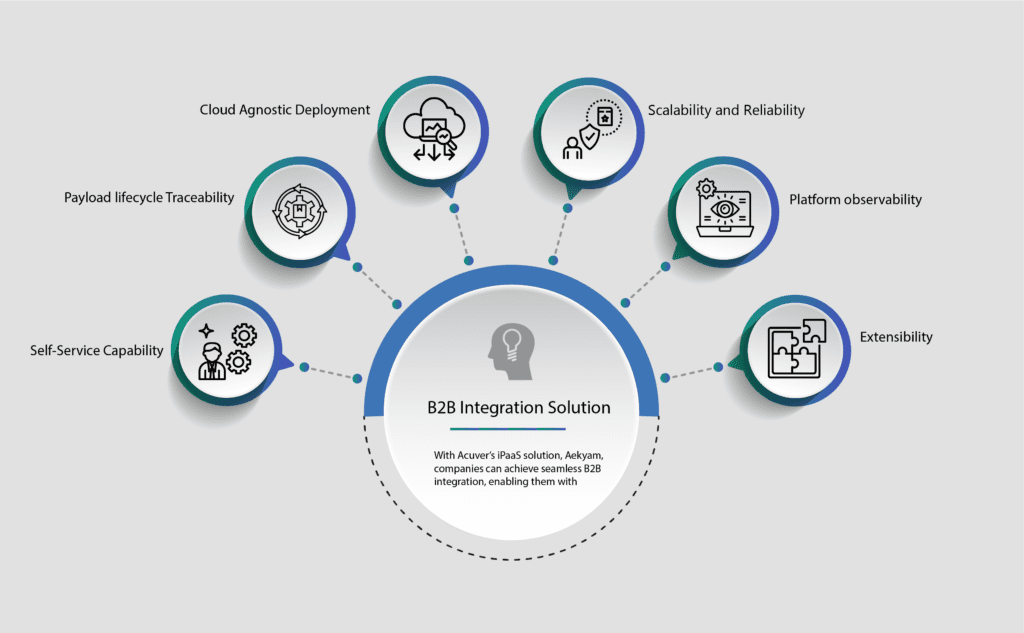
In today’s competitive landscape, you need to understand your customers better than anyone else. With an iPaaS, you will be able to:
- Improve the overall customer experience and customer retention
- Break down data silos
- Promote data consistency, quality, and security
In short, iPaaS empowers enterprises to navigate the complexities of modern business with confidence and efficiency.
Aekyam, our proven integration platform, is trusted by clients worldwide. The platform allows its users to go deep into errors and detect the exact problem which, in turn, allows for a quick resolution.
By delivering unparalleled ease, adaptability, flexibility, scalability and optimized hosting cost, this adaptable solution can handle all your data and integration requirements. If you’re looking for an iPaaS as a strategic enabler for driving digital transformation and gaining a competitive edge, get in touch with our team of experts to understand your way forward.
Share
Read Similar Blogs

